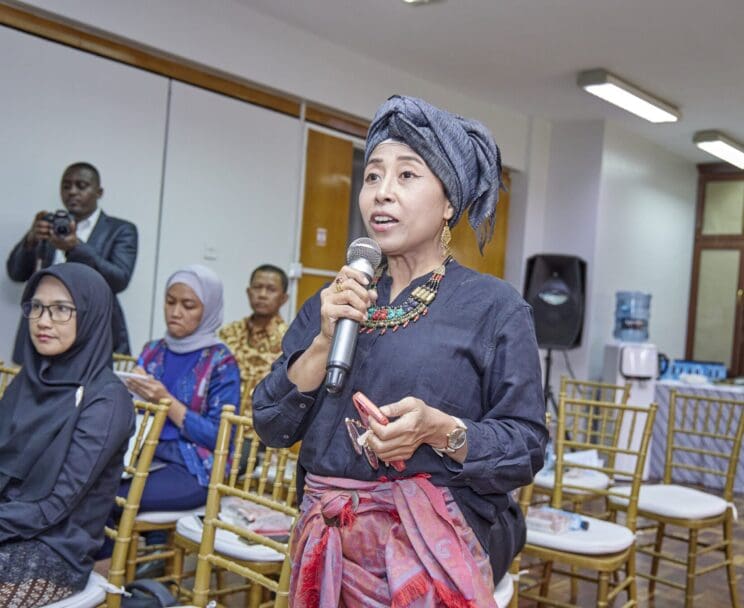



Whose knowledge counts when we build peace? Ruby Kholifah, an Indonesian expert on women, peace and security, gender and religion, leads our partner AMAN Indonesia. After exchanging experiences with women peacebuilders from around the world at the ICAN Forum in The Hague, she reflects on a question at the heart of her work: whose knowledge counts?
On the 30th of September 2026, I joined women peacebuilders from more than 40 conflict- and crisis-affected countries at the ICAN Women, Peace and Security Forum in The Hague. I came to share what we have learned from grassroots women peacebuilders in Indonesia, and to exchange experiences with women working in very different circumstances.
Women from Yemen, Iraq, Palestine, Myanmar, South Sudan and elsewhere spoke about working amid war, displacement and political repression. Listening to them was a reminder that peacebuilding is never an abstract framework. It is about supporting survivors, organising humanitarian assistance, documenting violence, maintaining dialogue between divided communities, protecting children and creating enough safety for women to continue their work.
For me, these experiences connect to a question that also appears in our work in Indonesia: when women share what they have learned through years of building peace in their communities, do we recognise that as knowledge?
When experience becomes knowledge
I have seen this question very clearly in Indonesia. Many grassroots women have spent years organising their communities, responding to violence, supporting survivors, mediating tensions and negotiating with village and religious leaders. Yet many of these women do not initially describe these experiences as knowledge. When we ask about their work, they often simply say: this is what I did.
We initially began documenting their experiences because we wanted to make their peacebuilding work more visible. Over time, we discovered that the process itself was doing something important. Through repeated interviews, writing, discussion and retelling, women began looking differently at their own work. They became more aware of the strategies they had developed, the power relations they had negotiated and the changes they had helped create. They could explain more clearly why they had chosen a certain strategy, what resistance they had faced, what had worked, what had not and what others could learn from their experience.
Actions that had once seemed like ordinary community work became recognisable as leadership, mediation, protection and peacebuilding.
This was one of the most important lessons for us. Documentation does more than record knowledge that already exists. It can also become a process of consolidating that knowledge. Women learn from reflecting on their own stories, while we learn from listening more closely to their experiences.
How peace is actually built
This matters because there is still a hierarchy in many peacebuilding spaces. Grassroots women are often invited to share their stories and experiences. Researchers, policymakers and other recognised experts are then expected to provide the analysis. That division overlooks what is already present in the women’s own work. Their lived experiences already contain analysis. What is often missing is the time and space to reflect on those experiences, organise them, name them and claim them as knowledge.
When we listen closely, we also begin to notice forms of knowledge that formal peacebuilding frameworks can easily overlook: how women recognise early signs of tension through everyday relationships, how informal networks function as systems of protection, how women negotiate within families before entering public spaces, how religious language can either close or open political space, and how rebuilding trust between neighbours can become part of conflict prevention. These experiences tell us something essential about how peace is actually built.
Who gets to interpret religion?
The question of whose knowledge counts also appears in another important part of my work: religion and women’s rights. In Indonesia, religion is deeply embedded in everyday life. It shapes family relationships, social norms, political language, ideas about morality and public authority. Any serious effort towards gender equality therefore has to engage with religion and with the interpretations that influence people’s lives.
Indonesia has a long history of Muslim women serving as religious scholars, educators, organisers and community leaders. Today, that tradition is visible in KUPI, the Indonesian Women Ulama Congress. KUPI challenges the assumption that women are merely the objects of religious interpretation. Women themselves produce Islamic knowledge, and their lived experiences form part of the process through which religious questions are understood.
That has real consequences. Experiences of sexual violence, child marriage, ecological destruction, discrimination and inequality become part of the process of interpreting religion. The question is no longer only what a religious text says. We also need to ask what happens to women when a particular interpretation is applied. Who benefits? Who is harmed? And does that interpretation produce justice?
These questions change more than the interpretation itself. They also change whose experiences are recognised as legitimate sources of knowledge and where religious authority is located. For me, this connects directly to what we see among grassroots women peacebuilders. In both cases, women possess knowledge that has often remained insufficiently recognised. One comes from years of navigating conflict, relationships and community life. The other also concerns the authority to interpret religion and to bring women’s experiences into that interpretation.
The underlying question is the same: who is allowed to produce knowledge, and whose knowledge carries weight?
Reimagining security
The conversations at the ICAN Forum made that question even more visible to me. Women working in very different contexts described complex strategies for keeping people safe, maintaining relationships and creating room for peace.
We should also be careful with the way we talk about their resilience. Women should not continually be expected to endure violence, repression or exclusion because institutions fail to protect them. Celebrating their ability to survive can distract from another question: why do women continue to carry such a disproportionate share of insecurity, and what needs to change so that survival is no longer treated as the measure of their strength?
Reimagining security therefore also requires us to reconsider authority.
Women affected by conflict are often described as victims, beneficiaries or storytellers. Those descriptions capture only part of who they are. They are also knowledge producers, political actors, religious thinkers, mediators and peacebuilders. Through years of working inside their communities, they have developed knowledge about how violence emerges, how exclusion can be challenged and how trust can be restored.
If we want to understand how peace is created and sustained, that knowledge deserves a central place in the conversation. The women sharing their experiences are not standing outside the “real” peace process. Their experiences contain knowledge about how peace is actually built.